Archive for February, 2010

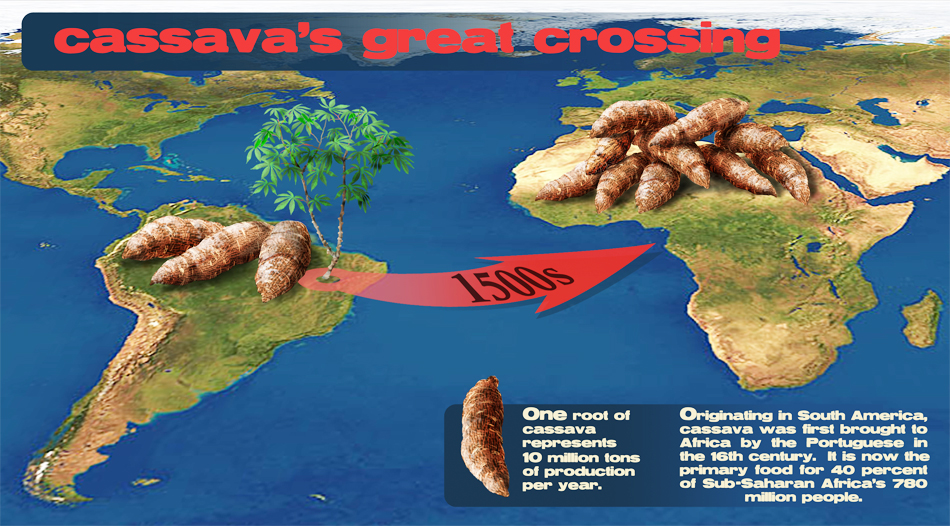
How many people in Africa owe their existence to cassava crossing the Altantic?

Cassava is a profoundly vital plant that can take credit for sustaining millions of people (i.e. poor farmers and their families) every day across the tropics, especially in Africa.  Africa produces more than the rest of the world combined for many reasons: it grows well in poor soils, is drought resistant, and can be left in the ground to be harvested when convenient.  I am fascinated by the human and natural history of all cultivated plants (and thus foods), so I created this graphic to explain the journey this plant has taken from South America to the main staple of Africa.

My own first experience eating cassava dates back to when I visited Madagascar.  In the arid central south, it was sold ready to eat much like a baked potato.  I thought it was flavorless but tolerable, and I ended up eating a lot of it because it was the most accessible food and easy to carry on my bike.

Some years later when visiting Cameroon, I again ate a lot of cassava, but this time pureed, boiled, then cooled in a long rubbery baton du manioc called “Mbobolo”.   It felt like a giant prosthetic ET finger!  You would unravel the cassava tube (~2 feet long and ~1 inch in diameter) from its tight banana leaf wrap, and dip the semi-opaque rod into a folded-banana-leaf satchel of spicy peanut butter.  Scrumptious.

And it was there in Cameroon that I learned that cassava had to be processed to be edible- well, I mean eaten without giving you goiter, paralysis, or disease!  There are malevolent forces (science calls it cyanide) ready to wreak havok when one eats cassava not thoroughly processed.  There are a few ways different culinary traditions do it, but generally it is to let it soak in water and ferment for hours or days.

check out wikipedia’s article on it   http://en.wikipedia.org/wiki/Cassava

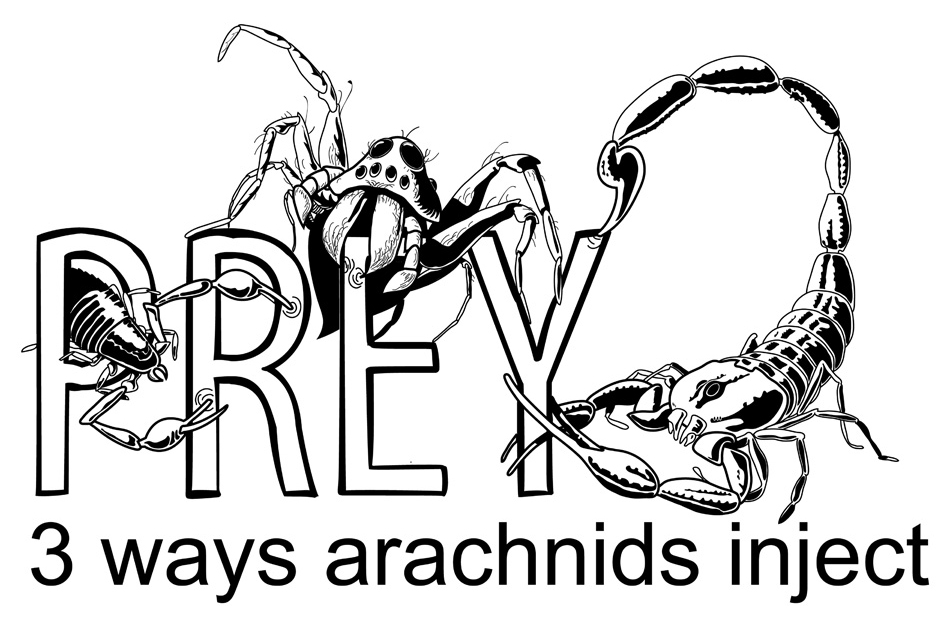
3 ways that arachnids inject venom into their prey


I made this graphic to showcase the incredible evolution of venom-injecting structures that these major groups of arachnids have independently arrived at.  The scorpion thru the telson, or the tip if the “tail”; the wolf spider (you can tell by the eye arrangement- check out the lower row of 4 eyes!) injects via fangs at the tip of its chelicerae.  Lastly the pseudoscorpion has venom administered via its vestigial pedipalps- it even evolved an opposable thumb to compliment it!  And we thought we were special?

Illustrating a tiny, tiny spider for the Cal Academy

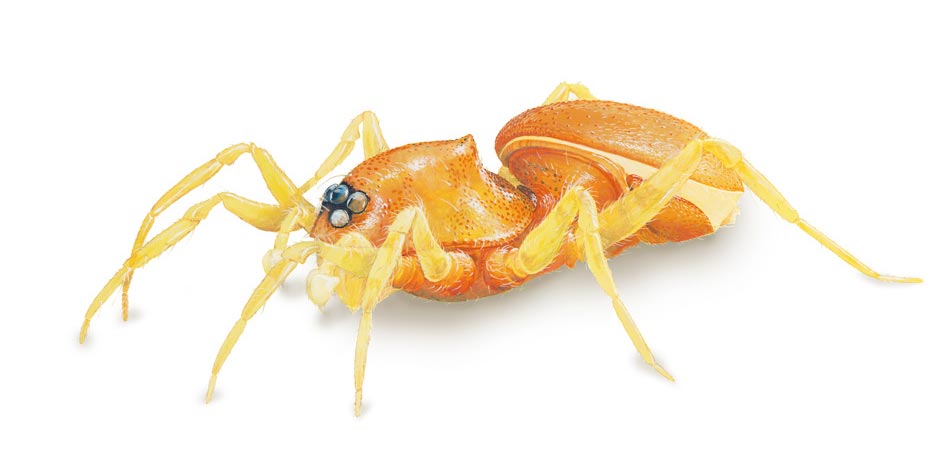
This extremely tiny spider (~1mm across!)  is called Silhouettella assumptia and is from an elusive and little known family of spiders called Oonopidae.  They are known to lay people as the “goblin” spiders, but to latin linguists in labcoats the Oonopidae means egg-eyes.

3/4 view of the Oonopid Silhouettella assumptia

Illustrating a  spider requires special techniques.  They are different from insects in that their exoskeletons aren’t as hard all around- many parts will shrivel up so they must be stored in alcohol.  That’s why you don’t see all the gorgeous spiders of the world mounted in cases next to insects in Natural History museums!  (…but not to discredit the world’s bias for insects and against all things arachnid- it is real!!  you must teach the next generation to love them!)  For example if you try to dry and mount a spider, likely the abdomen will quickly resemble a raisin.  A terrible inconvenience.

For this project I had to keep the specimen submerged in liquid so that it wouldn’t dry out, and surprisingly (to me) sand is used at the bottom of the liquid petri dish to help steady it.  This enables me to study under a stereo microscope and a powerful light.   I also had access to “stacked focus” digital images if many different angles.  I had the experts around me at the Cal Academy to help me come up with the illustrated posture, (and crucially) the relative lengths of the legs.

I rendered the image in gouache, and stroked the many different colored hairs in colored pencil right over the paint…a great combination!   The original drop shadow I painted underneath was quite disappointing, so I opted to make a subtle digital one instead.

Are there any other spider lovers out there on the WWW?